Platform vs. Point Solution: Why This Choice Defines Your Next Five Years

In senior care, most technology decisions are framed as feature comparisons.
- Does it detect falls?
- Does it send alerts?
- Does it integrate enough?
But the more important question is this:
Are you buying a point solution—or a platform built on AI that evolves with you?
Because this affects how your team works every day. And it directly determines whether you’re keeping up with senior care … or leading it.
What a Point Solution Really Is
A point solution is built to solve one problem.
Maybe it's fall detection. Or nurse call. Messaging. Analytics.
Individually, many of these tools work. But point solutions aren’t made to adjust to changing needs. When that happens, the answer is always: add another system.
The result:
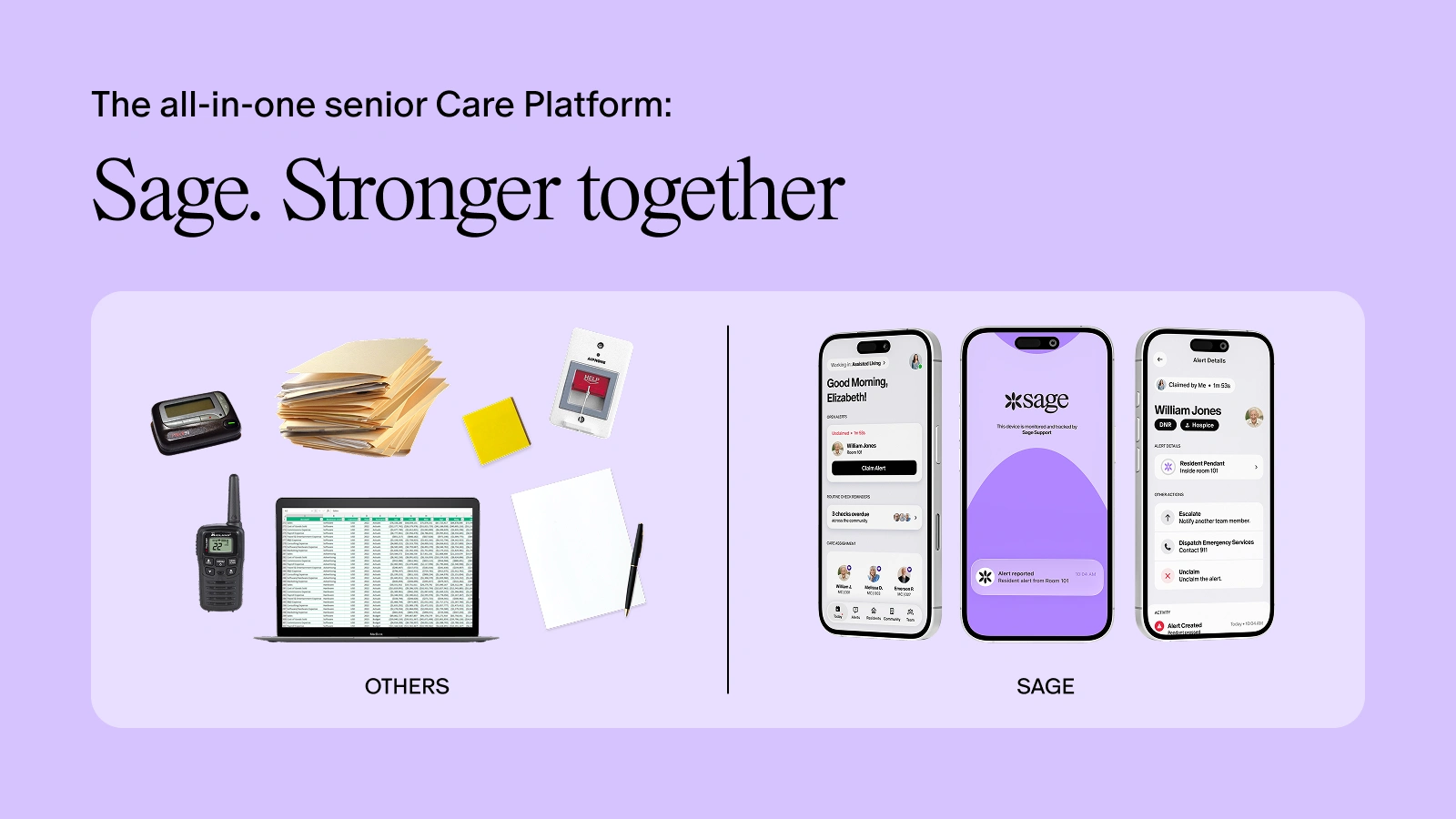
- Caregivers juggle multiple tools, each with its own login, interface and workflow.
- Important information gets stuck in separate systems instead of being shared.
- Processes that work in one community often fall apart when you try to use them across many.
- You end up with more systems to manage, not better results.”
Point solutions may help with one task, but they don't grow with your community. So when everything in senior care is changing quickly—staffing, regulations, resident needs—these fixed tools fall behind quickly.
What a Platform Actually Does
A platform is designed to grow. It connects people, workflows, and data today—and makes it possible to add new capabilities tomorrow without disrupting care.
That matters because senior care is not a fixed environment. Regulations change. Acuity rises. Staffing models shift. Expectations from residents and families evolve.
A true platform can grow with you, work across different types of communities, stay consistent as you expand, and make it easy to add new features over time.
This is why Sage was built as a platform—not a collection of tools.
Why This Difference Matters
For COOs and CCOs:
Labor is the biggest constraint. A platform makes everyday work easier—and keeps doing that as you grow.
With Sage Core, communities see up to 60% faster response times, and as new workflows or capabilities are added, caregivers don’t have to relearn how care works.
For CEOs and Owners:
Growth requires flexibility. Whether you’re adding communities, adjusting care models, or responding to new regulations, a platform scales with your business instead of holding it back. Fewer falls and fewer ER transfers mean stronger occupancy and more predictable revenue—without adding operational complexity.
For Clinical Leaders:
Reliability, privacy, and continuity are non-negotiable. With a platform, you get a reliable system you can trust, while still being able to add new features when you need them.
What’s Happening Across the Industry
Some vendors piece together different products and call it a platform. . But the truth is that they buy cameras from one manufacturer, sensors from another, and tablets from a third. They use extra software to make the parts talk to each other.
On a demo, it might look seamless. But in year two, the cracks begin to show.
Here are some of the problems we hear from clients who had been using point solution technology:
- Systems fail… and you’re responsible. . When a vendor stops supporting a device or changes something behind the scenes, your "platform" vendor is scrambling to patch things—and your caregivers are stuck with a system that's down or inconsistent across buildings.
- Systems aren’t “smart” together.. These systems can share data, but they can't use it together in a meaningful way. Fall detection sends an alert. Analytics show a trend. But they don't inform each other in real time—because there's no unified AI layer learning from everything at once.
- Things only move as fast as the slowest company in the chain. Want a new capability? Your vendor has to wait for their hardware supplier to build it, or find a new supplier and re-integrate everything.
With Sage, hardware and software are purpose-built together. We control the full stack. So when you need something fixed or upgraded, there’s one team responsible—not a bunch of vendors pointing fingers.
The Question to Ask
When evaluating technology: "Did you build this from the ground up—or assemble it from parts someone else makes?"
If a vendor is selling you a bunch of connections, you’re signing up for extra work—not a real platform.
A Platform That Grows With You
⏰ Point solutions are built for a moment in time. Platforms are built for what comes next.
🏗️ Point solutions ask operators to keep rebuilding their tech stack. Platforms let them keep building on it.
Sage allows communities to:
- Expand capabilities as acuity, staffing, or regulations change
- Maintain a single caregiver experience, even as systems evolve
- Avoid having to replace hardware every few years
In an industry defined by change, flexibility isn’t a “nice to have”: It’s a requirement. That’s the difference between a point solution and a platform. And it’s why the choice matters.
Want to learn more about Sage’s platform solution? Connect with us!
.jpg)