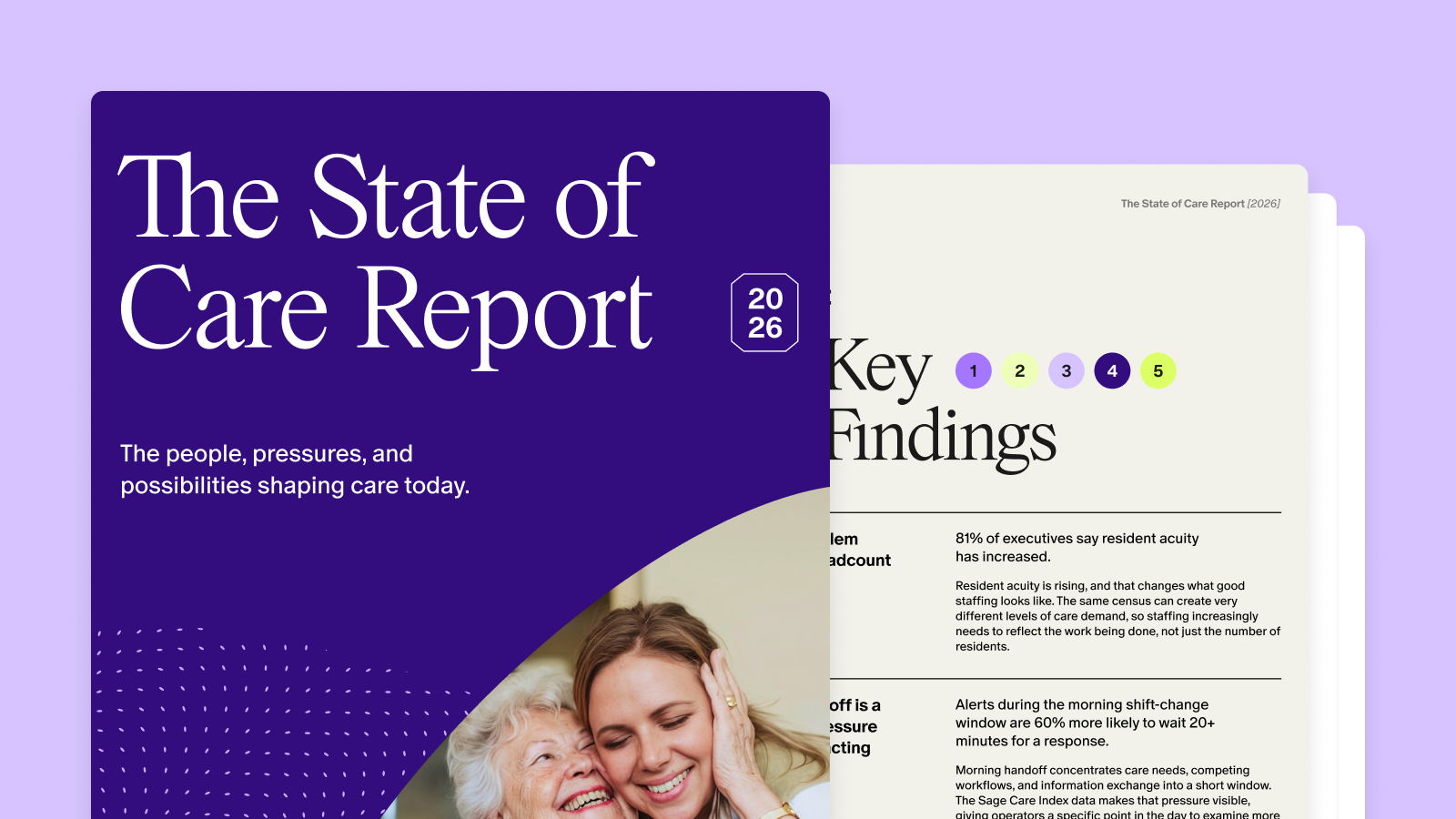
The State of Care 2026: What 510 senior living professionals and Sage’s operational data reveal

Senior living operators do not need another report telling them the work is hard.
Resident needs are becoming more complex and caregivers are stretched to their max capacity. Technology is everywhere, but it doesn't always make the work easier. Operators are being asked to improve care, control labor, protect occupancy, and prepare for a much larger aging population, all at once.
What's harder to see is where those pressures actually show up inside a community, and what operators can do about them.
That is what we set out to understand with The State of Care 2026.
Between July and August, Sage surveyed 510 senior living professionals, including 138 executives and owners and 372 community leaders and caregivers. We asked what is changing, where teams are struggling, how technology is helping or getting in the way, and what would give caregivers more time with residents.
Then we looked at those perspectives alongside the Sage Care Index, our analysis of operational data from communities using Sage. The goal wasn't simply to compare what leaders think against what caregivers think. It was to put real operational data behind experiences that a monthly report or P&L can't show.
Five findings stood out.
1. The staffing problem is not just about headcount
81% of executives say resident acuity has increased.
That changes what good staffing looks like.
Two communities can have the same census and require very different amounts of caregiver time. Even within the same community, demand shifts based on resident needs, care activity, and when that care is required.
The pressure is already visible to teams. More than half of community leaders and caregivers say they end their shifts mentally exhausted most or every day, and only 12% say they always have enough team members to provide the level of care residents deserve.
Executives often see that pressure through different signals: turnover, call-offs. Caregivers experience it personally, one shift at a time.
For operators, that means staffing models increasingly need to answer a more useful question than "How many residents do we have?"
How much care is actually being delivered, and when is that work happening?
The answer matters for both care quality and labor efficiency. The Sage Care Index shows real opportunities to better align revenue and labor with the care actually being delivered inside communities.
2. Morning handoff is a measurable response-time pressure point
Some operational problems are broad, but this one has a set time frame that can be fixed.
Across 323 communities analyzed from June through August 2026, alerts during the 6–8 a.m. morning shift-change window were about 60% more likely to wait more than 20 minutes for a response than alerts during the rest of the day.
Within that window, 13.3% of alerts waited more than 20 minutes, compared with 8.2% during the rest of the day. What makes this particularly telling: overall alert volume actually peaks later in the day.
So the morning slowdown isn't simply about call volume. It looks more like handoffs, scheduled care, residents waking up, coverage, and other competing demands all colliding in a short window.
That gives operators something specific to investigate.
Instead of asking only whether staffing is sufficient overall, leaders can look at how those two hours are designed. What happens during handoffs? What scheduled work is competing for attention? Where are caregivers moving between systems or responsibilities? Are monthly averages hiding a short but meaningful pressure point?
The implications may reach beyond response time itself. In a separate, preliminary analysis of roughly 130 communities, faster average caregiver response tracked with lower 90-day move-out rates. The gap between faster- and slower-response communities was worth an estimated $23 per resident per month.
The analysis is observational, but it raises an important question: if residents consistently wait longer for care, what does that mean for retention?
3. The technology problem is not too many alerts. It's too many systems.
Senior living has invested heavily in technology in the last couple of years. The challenge is that many of those tools still function as separate destinations.
A caregiver may need to move between nurse call, fall management, and the EHR just to understand what happened, respond, and document the care.
In the survey, the friction caregivers are feeling is how many systems they have to use. 44% of community teams cite switching between systems as a frustration, compared with just 12% who cite too many alerts. Documentation burden and poor communication between systems reinforce the same issue.
That changes the technology conversation.
The answer isn't necessarily another point solution or another alert. The opportunity is to reduce the number of places caregivers have to go to complete a workflow.
For operators evaluating new technology, that creates a useful test: Does this tool remove steps from the caregiver's day, or add another place they have to look?
Technology should make it easier to understand what happened, act on it, document it, and move on to the next resident.
4. Caregivers are not the barrier to AI adoption
One of the clearest findings in the survey: community teams are open to better technology. Nearly two-thirds of community leaders and caregivers say they are very or cautiously open to AI supporting their work.
At the same time, only 32% say the technology they use today generally helps them. That gap should matter to operators and their technology partners.
The question may not be whether caregivers are willing to use new technology. It's whether the technology is useful enough to earn their trust. Executives point to similar priorities. Cost, privacy, and reliability all rank ahead of caregiver resistance as concerns about AI adoption.
That raises the standard for AI in senior living. New technology can't simply add more data or more alerts. It needs to improve outcomes, reduce burden, and fit naturally into existing care workflows.
Fall management is one area where that value can begin to be measured. In an early analysis of a higher-risk group of 88 Assisted Living residents with a prior recorded fall, falls declined 28% and hospitalizations following falls declined 73% during the 90 days after Sage Detect activation. Those results are specific to that subgroup, not the entire Detect portfolio, but they illustrate the kind of outcome operators will increasingly expect from AI.
5. Give caregivers time back, and they will give it to residents
We asked community leaders and caregivers a simple question: If you had one additional hour in your shift, how would you spend it? Seven in ten chose resident engagement or direct care.
About 40% chose resident engagement. Another 31% chose direct care. Only about 6% chose documentation.
That's not surprising: caregivers care about residents. What's useful is what it says about the purpose of efficiency. The goal shouldn't simply be to fit more tasks into a shift.
It should be to reduce the administrative, workflow, and technology burden that pulls caregivers away from residents in the first place.
That gives operators a clear standard for staffing, workflow, and technology decisions:
Does this create more capacity for the work residents actually feel?
Go beyond the report
The full State of Care 2026 includes the complete survey findings, Sage Care Index benchmarks, care-setting comparisons, operational analyses, and methodology behind the research.
We also wanted operators to be able to do something with the data.
On the State of Care interactive experience, you can benchmark a community or portfolio against Sage Care Index data across areas including morning response performance, 90-day move-outs, level-of-care revenue, clinical labor, and fall response.
You can see where your organization compares, explore potential opportunities, and download a personalized view of your results.
Because the most useful question isn't simply "What is happening across senior living?"
It's:
"What is happening inside our communities, and where should we look next?"