Every Minute Matters: How Real-Time Care Data Could Save Your Communities More Than $27,000 Annually
Senior Housing News webinar, presented by Sage
Speakers
Austin Montgomery, Host, Senior Housing News
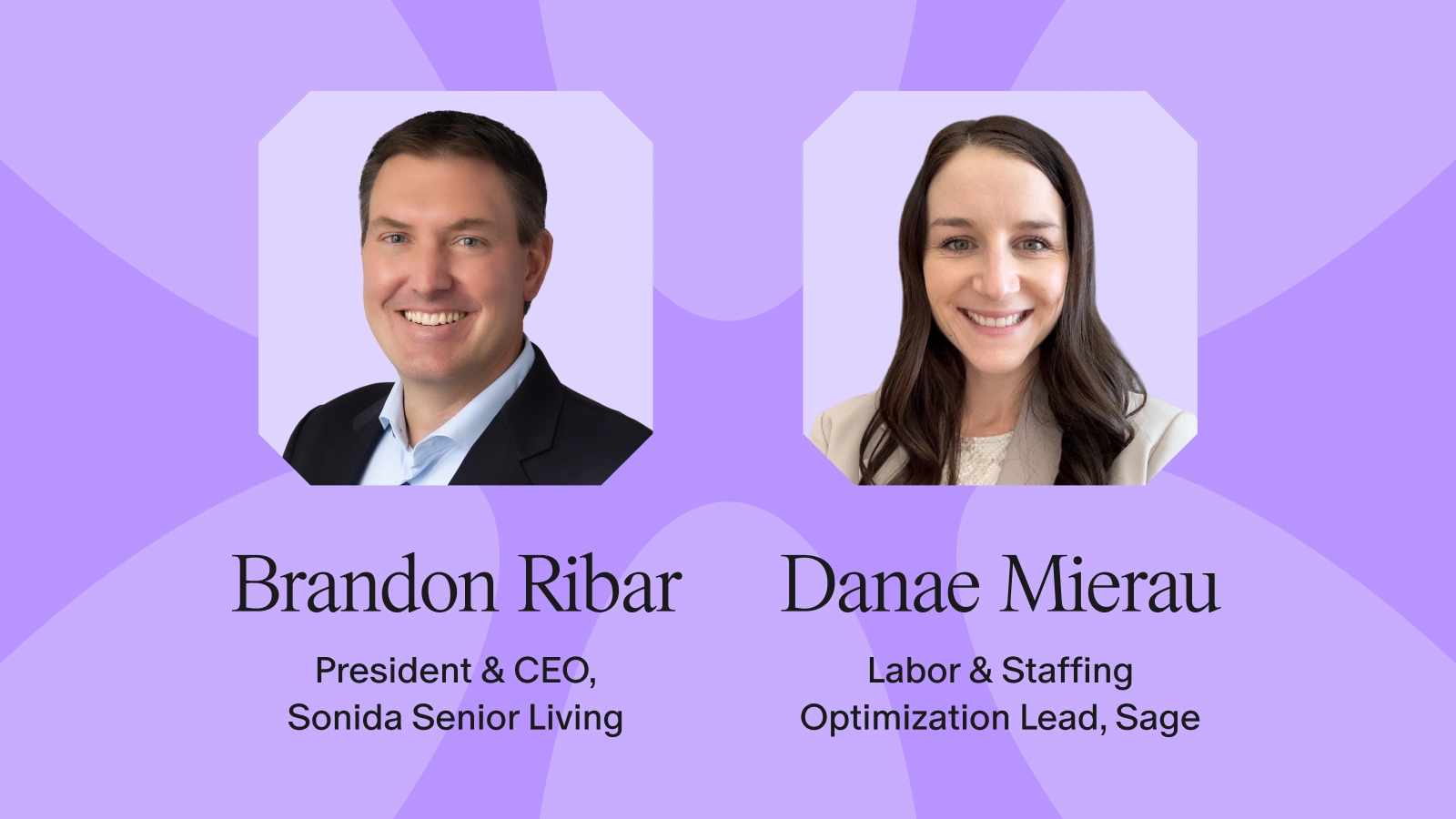
Sue Coppola, Senior Vice President of Clinical Services, Sabra Healthcare REIT. Former Chief Clinical Officer, Sunrise Senior Living.
Tim Hearn, Vice President of Client Success, Sage
WELCOME AND HOUSEKEEPING
Austin Montgomery: Welcome, everyone, and thank you for joining us. I’m Austin Montgomery for Senior Housing News. Today’s session is Every Minute Matters: How Real-Time Care Data Could Save Your Communities More Than $27,000 Annually, presented by Sage.
This session is being recorded, and the replay will go out to all registrants for on-demand viewing. Please add your questions in the Q&A box at any time. We will address them as they come in, but most likely in a short Q&A portion at the end of our conversation.
A quick run through of attendee tools: you can ask a question at any point during the presentation, and you can arrange the boxes in the presentation window to format the ON24 platform however you would like while viewing.
Now a quick note about our sponsor. Sage provides nurse call and fall management technology for senior living communities. Its platform uses artificial intelligence to help care teams know when a resident needs help, respond faster, and keep care workflows connected. Because that technology records how care happens day to day, including how quickly staff respond, Sage can help see patterns across many communities that don’t show up on a financial report. I think today is all about the data, so I’m really excited to dive into this conversation.
A few more housekeeping items before I introduce our speakers. If you have any difficulty viewing the platform, sometimes the simplest option is the best one: refresh your browser. The ON24 platform also doesn’t always interact well with multiple tabs open. If you’re like me, with up to two dozen tabs open at a time, closing some of them may resolve memory issues and fix any video lag. There is also a help function in the ON24 platform, under the three caret bars, with additional troubleshooting options. As a last resort, we have a webinar team member on standby who can address platform questions through the Q&A function.
Now I would like to introduce our speakers. I am joined by Sue Coppola, senior vice president of clinical services at Sabra Healthcare REIT, where she leads clinical innovation and technology strategy, participates in environmental and social governance, and works at the intersection of health and wellness, due diligence, and risk management across a national portfolio. She has more than three decades of executive experience and previously served as chief clinical officer at Sunrise Senior Living. Sue, thanks for joining us.
Sue Coppola: Delighted to be here.
Austin Montgomery: We’re glad to have you. Sue is joined by Tim Hearn, vice president of client success at Sage. Sage partners with senior living communities to help them get lasting value from the Sage platform, working with clients from implementation through ongoing support.
Tim Hearn: Thank you.
Austin Montgomery: Thank you so much, Tim. I think this is going to be a great conversation, and an important one, because we’re at a time when occupancy, staff turnover, labor costs, and resident satisfaction help tell a story about how communities are doing. But what can we track to spot problems sooner, decide where to put resources, and improve care?
Over the next hour, we will cover some key areas: what metrics to track alongside your financial and occupancy numbers, how to tell whether staffing matches resident needs and where more support could help, and how much early move-outs cost your communities and where you could save.
BEHIND THE NUMBERS
Austin Montgomery: Let’s dive into our first section, behind the numbers. We’ll start with Sue. You’ve led care at operators and across a national portfolio over the years. How has your reporting evolved, and what are you seeing right now?
Sue Coppola: Years ago, we didn’t have data at our fingertips. It was all a retrospective look back, and a lot of it was self-reported. Even today with technology, if the data isn’t accurate, the first step is to seek to understand. But the beauty now is that we get information much closer to real time, and that allows us to validate it and act on it more quickly to improve the quality of life of our residents and our team members.
We can’t forget how much these solutions help our team members. Hopefully they improve workflows so that staff can spend more time with the residents, which is what they love, versus reacting to the noise in the environment. It’s an exciting time for all of us.
Austin Montgomery: Are there certain things you pay attention to as you look at how you’re getting this data and how reporting has evolved? Is there anything you prioritize?
Sue Coppola: A few things. One is the ease of the data and how it lays out. In addition, when thinking about a system such as Sage or other e-call systems, how quickly can our residents get a response, and how does that connect to resident satisfaction, move-outs, and quality of service? For our team members, it’s the ability to balance their workload, and their satisfaction.
In essence, does the technology improve the quality of life of the residents and the team members? Are we able to look at a return on our investment in that threefold way: team member satisfaction, resident and family satisfaction, and ease of use?
Austin Montgomery: All of those things are critical, not only to making communities run smoothly, but to having data in front of you that leads to actionable decisions, both for community leaders and for corporate leaders at the top. Tim, you work in so many communities across the country, and Sage has looked closely at how reporting has evolved. What are you finding right now?
Tim Hearn: The good news is that data is more and more available, especially care data, because care data is going to tell you what’s happening at the community far better than any of your other data sources. This is what Sage was built for. We’re a nurse call, fall detection, and wander management system, but the real differentiator is that we capture every moment of care, at the point of care, in real time, as Sue said. That’s powerful because you can track resident and community-wide acuity in real time.
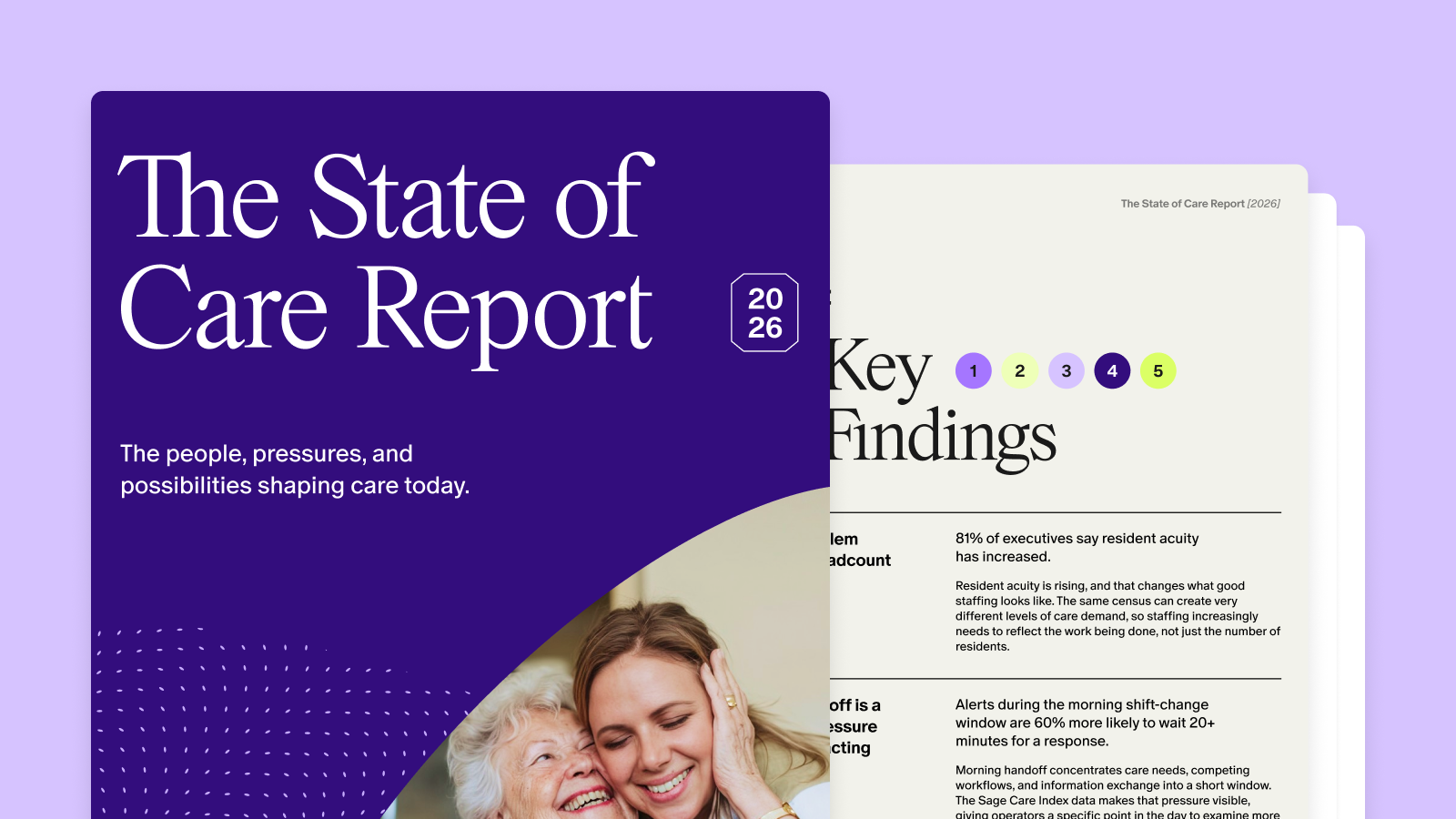
We hear stories from communities every day, and we help tell their story through data. In our report, 88% of care team members say there isn’t enough staff to meet the requirements of residents. We look at the data and say, that’s right: the level of acuity is increasing and outpacing the standard labor census. We can validate how they’re feeling. That is what our client success team does with communities every day, and with the State of Care report we’ve now been able to do it at a macro level. We interviewed 510 people, 138 of them executives and 372 at the community level, and paired that with the data our system captures on the ground at all of these communities. We’re really excited to share our findings.
Austin Montgomery: In the lead-up to this, we were workshopping some of that data, and one point stood out to me: 81% of executives in the survey said resident acuity had increased over the past two years, and only 12% of community staff say they always have enough team members. It seems like a critical time for this type of validation, and for a care platform to be as cohesive as possible when acuity is putting more pressure on operations.
Sue Coppola: If I could add, we’ve been very used to documenting scheduled tasks. Where we get better views now is the unscheduled tasks and services being provided to residents, which gives us a full picture of the resident’s needs.
Austin Montgomery: Tim, before we move on, is there anything else from the State of Care report you want to touch on?
Tim Hearn: We’re going to get to more of it. Of the executives, 81% are seeing acuity rise, and 84% say providing care at the community is more complex as well. When both executives and the people at the community are saying the same thing, it’s time to listen, and time to use the data to make changes.
Austin Montgomery: As we mentioned at the top, it’s a critical time. Demand is very strong, but operations are getting more complex, which is what we hear anecdotally from operators across many markets. Tim, whether a leader already has care data or is just starting to weave it together, what should they look at first to bring actionable insights into operations?
Tim Hearn: Look at your nurse call system and identify what data you can get. I would start with response time, because it connects to almost everything else: staffing, falls, resident experience, and move-outs. Understand whether you’re currently meeting the service level your residents and their families expect.
Then go a layer deeper. Check what percentage of alerts are waiting longer than, say, 20 minutes, and pair that with the financial metrics you already have, like occupancy, labor cost, move-outs, and care revenue, to see if there’s a correlation. If you have Sage, this information is already on your dashboard and already calculated. If you don’t, that’s okay. Find those data points, like response time, number of early move-outs, and care revenue, and upload them into the new benchmarking tool we launched alongside our State of Care report. You can see how you match up against industry benchmarks and standards. If you don’t have anything else, start with response times.
Austin Montgomery: Thanks, Tim. Sue, are there any recommendations or stories from your experience looking at care data across a portfolio and making actionable decisions from it?
Sue Coppola: I absolutely agree with Tim on starting with response times. The one caveat I’ll add is that I’ve seen too many leaders react to data rather than seek to understand it. My recommendation is to seek to understand the data. You do that by communicating with your team members, understanding resident needs, and validating the data and getting input on where to go next.
All of this information also gives us an opportunity to thank our team members for the work they do, and maybe coach them in the areas where they have an opportunity. That’s as valuable as everything else.
WHY RESPONSE TIME MATTERS
Austin Montgomery: Your point about it being a learning opportunity is critical at a time when so many operators are bringing on new staff, especially on the care side, and having to train them. Anytime you bring data into the conversation, you have to show folks why it makes it possible to make decisions quickly. That brings us to our next section: why response time matters.
Sue, you started your career in the ICU and in emergency nursing, where time is critical and every minute matters. How do you think about those critical minutes in a senior living community today, and how they relate to data analysis and having a cohesive care platform?
Sue Coppola: I think it comes down to dignity. Our seniors have lived a good long life and have been high contributors. When we respond quickly to their needs, it tells them that someone cares about them and is trying to meet their needs. It gives the resident and the family a feeling of safety and security. And in a medical emergency, minutes can make the difference between life and death, no different than in any other setting.
Think about the difference between a significant fall with a head injury where no one helps the resident for 20 minutes, or until the next check, which is not uncommon, and an immediate response that helps us get to emergency services much quicker. Response shows that we care and gives a feeling of security and safety, and it also helps the team member prioritize how they spend their time.
Austin Montgomery: Those are all important points. Tim, what does the data show about how quickly falls get a response today? Operators seem to be thinking about fall prevention and detection as a way to improve response times.
Tim Hearn: Fall detection systems are becoming more and more common, which is good news, because every minute after a fall matters tremendously. Long waits increase the likelihood of negative clinical outcomes, including hospitalizations and even fatalities, as Sue mentioned.
In our report, the median community responds to falls in under 10 minutes about 76% of the time. Said another way, one in four residents waits longer than 10 minutes after they fall, and that is the median community, so half of communities are doing worse. Falls waiting longer than 10 minutes is another data point to watch, because the risk continues to increase almost every minute after that. Response times go beyond falls, too: 8% of all alerts wait longer than 20 minutes regardless of alerting reason. As we’ll discuss, there are big implications for that.
Austin Montgomery: It’s important to get into more nuance, because that’s sometimes where the conversation about fall detection stops. Tim, this is the finding behind today’s title. What did Sage learn about response time and early move-outs when you had all the data in front of you?
Tim Hearn: This is where looking at data side by side becomes compelling. We broke communities into cohorts based on average response time: seven minutes or less, between seven and 12 minutes, and 12 minutes or more. Then we looked at early move-outs, meaning move-outs within the first 90 days, and asked whether there was a difference between the cohorts. It’s not a huge surprise, but it was a big correlation.
Communities with an average response time of seven minutes or less have on average 2.6 move-outs for every hundred residents each year, people who come in and leave before 90 days. In the cohort at 12 minutes or over, that number jumps to five, nearly double. The impact of response times on move-outs is highly correlated.
Most communities can approximate what a move-out costs them through turnover fees, sales spend, lost revenue, and so on. Our conservative data shows a cost of around $11,500 for every move-out. If you take the high cohort and the low cohort and bring your response time from 12 minutes to seven, you can avoid two and a half move-outs per year. Multiply that by the cost of a move-out, and that’s how you get the $27,000 figure.
The good news is that every minute matters. You don’t have to get down to seven to see a benefit. The cohort between seven and 12 minutes saw 3.9. Every minute you shave off that average reduces the likelihood that people move out early, because they feel, as Sue was saying, taken care of.
Austin Montgomery: That bears out what we hear from folks about care: time is of the essence. We’re always having conversations with operators about lost revenue days, which relates to the overall turn and the expensive process communities deal with when residents move out. Keeping residents in their units, happy, safe, and healthy is critical. Sue, when a resident moves out in the first 90 days, what is the real cost behind that, beyond the dollar figure?
Sue Coppola: In addition to the dollar figure, there is the emotional impact of a move-out on the resident and their family. When someone decides to make one of our communities their home, it’s a big decision, and a traumatic one. They’re changing their life. They arrive, maybe meet a few new friends, and start adjusting, but if they or their family are dissatisfied because of a lack of response time and a feeling of security, it’s very disruptive to think about moving again and starting all over.
It’s also disruptive to our team members, who develop emotional ties to our residents. Looking at everyone involved, it would just be easier to have satisfied residents who are receiving the right service and care at the right time in the right place. We used to have a term, “traumatic transfers,” and I think it applies here. A move-out within 90 days to another setting is very traumatic and could actually impact the longevity of a resident’s life. So it’s a critical component in addition to the financial impact.
Austin Montgomery: The mental toll of these transfers can affect residents and families, and overall a resident’s acuity. Any transfer is something to avoid if at all possible. Tim, how does acuity roll into all of this? Resident needs are evolving at a time when folks are overhauling their operations, from engagement and programming to care.
Tim Hearn: A couple of things are going on. Residents’ and families’ expectations are growing, and acuity is also growing. If you’re not tracking that in real time, or close to it, you’re staffing against higher expectations and higher acuity, and when you blend that together it creates strain on staff. One of the data points we found is that 56% of staff members finish their shift every day, or almost every day, feeling mentally exhausted. That is an outcome of these shifts.
Acuity is a huge portion of that. Not knowing what the acuity is at the community doesn’t allow the teams on the ground to staff appropriately to meet the needs and expectations of residents. Acuity going up gradually over time without us knowing plays a big role in what level of service we’re able to provide residents and their families.
Austin Montgomery: As a follow-up, why is it so important to look past averages and take the whole picture into account?
Tim Hearn: I mentioned looking at the peaks over 20 minutes. An average is a peanut butter spread. It’s a blend, and it hides data points that are actually really important. If at certain times of day we’re seeing responses over 20 minutes but the average is, say, eight minutes, I might conclude that community is good. At a granular level, there are periods of the day, which we’ll talk about later, where the average isn’t telling the whole story. Averages give you a good gut check, but one layer down is what tells you what’s actually happening.
I want to reiterate a point Sue made, and I’ll probably make it again: listen to the team. Go and talk to the team members on the ground. If you see an anomaly, the people working at that community know why. Often it’s these little anomalies that are the points where you should be focused.
Austin Montgomery: One of the most useful parts is diving into that data, figuring out which communities may need more focus and which shifts stand out, and building a new strategy for care response. Sue also raised an important point on burnout. We often hear folks describe staffing as a revolving door, and one of the ways some have made a dent in that is by overhauling their care platforms.
STAFFING, SHIFT HANDOFFS, AND WORKFLOW
Austin Montgomery: Now I want to shift to our next section, which I’m looking forward to because it offers practical tips for what leaders can do about staffing and about critical times of day, especially the morning handoff. Sue, when you think about staffing a community, what do you look at beyond headcount?
Sue Coppola: It’s important to understand the needs of the residents in totality. We’ve spent years staffing based on ratios or the proximity of apartments. Now, with more data, we can see residents’ scheduled and unscheduled needs and their service and care needs, and that lets us create a more balanced approach to staffing.
For example, one caregiver has 10 residents who are all independent, while another has 10 residents who are all two-person assists. How is that equal or fair? Then you have to manage with your team members why one has an assignment of six residents and another has 12 or 14. The data helps us be more precise around staffing and support, which helps our team members, reduces burden and burnout, and improves satisfaction. I think that is the greatest impact we can have when we look beyond headcount and ratios.
Austin Montgomery: Leaders are trying to match the team they have to resident needs, so it isn’t a numbers comparison of who’s handling what. It’s matching staff to the care that’s needed and to the residents who may require a little more. Tim, does the time of day play a role in how quickly help arrives for residents?
Tim Hearn: Yes, definitely. This was a super interesting finding, though not a surprising one when you think about it. The data shows that morning shift change is a bottleneck. Logically it makes sense: demand rises all at once. Residents are waking up, ADLs start, handoffs are happening, and documentation is due.
Between 6 and 8 a.m., instead of the average 8% of alerts going above 20 minutes, we see over 13% go above 20 minutes. That is across 1.76 million alerts, so this is a huge data set. It is a 60% increase in that 6 to 8 a.m. window, and the alert volume is not going up at that time. That points to workflow, and to an area of risk that the data shows undeniably: the morning shift between 6 and 8.
Austin Montgomery: That probably changes how you talk to teams about staffing, when to add workers or assistance, and how you note things in care planning, especially as personalization in care becomes more of a focus. Tim, when a leader finds a time of day that needs a closer look, or a repeated pattern of slow response in a certain window, what are the first steps?
Tim Hearn: I want to highlight that across our portfolio we see the morning window, but every community has different shift times and will see a different data set. You should do the same analysis on your own community. Start narrow. Pick one or two communities and don’t try to boil the ocean by picking your whole portfolio. See whether there are peaks in long wait times and whether they correlate with alert volume. If alerts are going up at certain times of day, that’s an important data point, and we can staff appropriately for it. If wait times are going up but alerts and care volume are not, that points to a workflow issue.
In that case, go to the community and talk to the staff who work those hours. They know what the bottlenecks are, and they will be happy to share them. They’ll appreciate that you’re there listening. Then make small tweaks. I wouldn’t recommend anything drastic to start. One community we talked to increased the handover time. They paid people to stay a little longer and come in a little earlier, which gave more time. That made everything much smoother and reduced their response times, and their move-outs went down. That little investment had a domino effect that was accretive to their bottom line.
So go and see what your team members tell you the bottlenecks are, make a small workflow, system, or staffing adjustment, and come back a couple of weeks later to see if there’s an improvement. One long-term point I can share with everybody is to reduce the number of systems you ask your team to use. This isn’t a short-term fix, but over 40% of the care teams we asked said switching between different systems was their biggest challenge and biggest time sink. That is especially cumbersome at handoff, so I would focus there as well.
Austin Montgomery: Are you also seeing in the data any positive impact on turnover or burnout once a critical time has been identified and adjusted?
Tim Hearn: This is interesting. For staff turnover, we need to work with a partner and get historical staff turnover data. There are a lot of reasons for a staff member to leave, so we’re not yet saying there’s a huge correlation between changes like this and staff turnover. Frankly, some staff turnover is desired. When I think about staff turnover, I’m thinking mostly about your top performers and making sure they stay longer. What we’re trying to prove now is that through system changes like this, by making workflows easier for them, we see those top performers staying. That will be a really interesting finding once we have more data behind it.
Austin Montgomery: Is there anything you’d touch on regarding a larger operator’s portfolio, where you’ve seen clinical labor spending come down on a per-resident basis?
Tim Hearn: You’re probably referring to work we’ve done with one of our largest clients, where we embedded a Sage team member in the portfolio. Their purpose was to go to the communities, work with executives, and work on labor. When you go to a community and say, “I want to optimize your labor,” nobody wants to talk to you, because what they rightfully hear is, “I’m going to take away your staff.” Everyone agrees there isn’t enough staff, so optimizing labor is a scary combination of words in this industry.
What we’ve gotten really good at is showing the acuity of the community, community-wide. What we are now getting good at is showing what labor would match that acuity. At certain times that actually isn’t reducing labor. It’s changing shifts so you’re covering the moving needs of acuity. Maybe it’s adding a fourth shift instead of three, spreading things out, and reducing overtime spend but not staffing. Across that portfolio, we were able to show a reduction in labor costs of about $100 per resident per month through these staffing and workflow changes. We measure everything on a per-resident-per-month basis. When you staff based on acuity and time of day, take handoffs into consideration, add a little here and reduce a headcount or overtime there, you get a much more efficient workflow. That efficiency reduces cost, not headcount, which I think is really important.
Austin Montgomery: That’s a nuanced conversation to have, because people may start out more apprehensive than willing to dive in. It sounds like it’s more of an adjustment than an overhaul.
Tim Hearn: We only felt comfortable doing this with our closest partner first, for that exact reason. You want someone you’ve already built trust with when you come in to do this, and it has to be a true collaboration. We literally embedded one of our employees within their portfolio and enterprise. That sort of partnership can show amazing benefits.
Austin Montgomery: That speaks to what’s needed to be responsive to evolving care needs in the sector right now. Sue, as leaders make some of these hard decisions, what do you want them to keep in mind about change that is necessary but difficult to take on?
Sue Coppola: Everything Tim said is right on. Having been in operations for many years, I’d say this is an efficiency factor, not a labor reduction effort. We’re better utilizing our teams. But it all starts with re-engineering your systems and processes to adapt to the technology, the dashboards, and the data that’s available. I see a lot of layering and stacking of technology that doesn’t allow team members and leadership to optimize their systems and processes. It may result in duplication and having to look at data in a variety of ways, when the point is to make everybody’s life a little easier. That’s number one.
The other piece is to be really clear in communication and to include team members, so we can make the adjustments that get us to a return on investment for our residents, our team members, and our investors who are investing in this technology.
HOW TO START
Austin Montgomery: Those are wonderful points on change management, and on what it takes to show folks the value and hold their hand along the way. Now I want to shift to how to start. Sue, performance varies by community. How do you decide what areas to focus on first when changing the way care is managed at the community level?
Sue Coppola: I always start with the resident. An accurate assessment allows us to build an accurate individual service plan, and that gives us more accurate data, whether it’s e-call technology or falls technology, as the basis for where we need to go. Starting with the resident assessment and evaluation is critical to getting to the next level of accuracy.
Austin Montgomery: You have a unique perspective given your long experience in the space and Sabra’s position. You can view this from the REIT side and as a former operator. Are there different challenges along the way, and how does that shape your view of care management?
Sue Coppola: We’re all in this together. As an investor, as a REIT, we want residents to get the best care and service and our team members to be well cared for and satisfied, because we know quality and service lead to great financial results, which get us our return. As a former operator, I’d be looking at the same thing. Where we sometimes get confused among ourselves is whether the system is being utilized and optimized in the way it’s intended. From a community leadership perspective, are they using it, and is it built into their daily, weekly, monthly, and quarterly business and management approaches? Without that, we’re not optimizing the software and technology, and we won’t get the outcomes we’re looking for in resident satisfaction and financial returns.
Austin Montgomery: It’s a delicate balance, but important. Falls are some of the most serious events at a community and some of the most abrupt changes in care level for residents. What changes when a team understands why a fall happened, rather than just responding to it?
Sue Coppola: With falls technology we also pick up more falls, and I want to address that. Often we see an increase in falls because of all the previously unreported falls that we now have the ability to act on. We can speak with the resident and their family, do a root cause analysis, and add to the service plan. We can’t always prevent falls. But for the resident who has fallen, the big difference is that we can see whether a resident with a memory impairment hit their head or didn’t. If they didn’t hit their head, you can generally maintain them in the community as long as they aren’t showing any other adverse symptom. Today, a lot of residents are transferred to the ER because we don’t know whether they hit their head. That’s very traumatic, costly to the system, and challenging for residents, families, and team members. From my perspective, being able to know whether a resident hit their head, and whether that affects a transfer out to a hospital ER, is one of the biggest wins in falls technology.
Austin Montgomery: That illustrates the problem folks face, because there’s a physical and emotional toll on everyone: the resident, the staff, and their families. Tim, what does the data show about understanding the why behind falls rather than just responding to them?
Tim Hearn: You will not be surprised that Sue is spot on. This is exactly what we’re seeing. Our fall detection system is AI-based, and we also learned in this report that 64% of care teams are excited to adopt AI, which is great, because when used properly it gives us extra eyes and extra context on what’s going on.
To Sue’s first point, when you put in a new fall detection system, expect falls to go up, because you’ll catch a lot of falls you previously wouldn’t have. Someone falls, gets up on their own, and you come back for your check without knowing they were on the ground for 30 minutes. There’s no way of knowing. That matters for rising acuity: it’s a data point that was missed that we now capture and can add to the care plan.
When you have context around falls and understand why they’re happening, a lot of the time it’s something like a carpet in the hallway, or a new robe from family that’s two inches too long, or blinds that catch. Those are quick changes to make. So we looked at people who had fallen and asked what happened after we installed this technology. Among previous fallers, repeat falls were reduced by 28%, and the number of hospitalizations from falls went down by 73%. That is life-changing for many of these individuals and their families. The technology creates context that helps you change the environment to reduce the risk of falls, and therefore the risk of negative clinical outcomes.
It was also exciting to hear that care teams are more and more willing to adopt this technology because they see the value. When you’ve been caring for a resident for a long time and you know them well, and they fall, that hurts. When we can reduce that using technology that people trust, we all win.
Austin Montgomery: Before we move on, is that data point across Sage’s whole portfolio, or is it more nuanced? A 73% decrease is huge regardless of how you cut it.
Tim Hearn: We took communities that opted in to our AI fall detection system, because that’s what truly gives you the context. We identified people who had fallen multiple times, put the technology in, and looked at the next few months to see how many falls occurred compared with what we would have expected. Falls decreased by 28% total for that population, and hospitalizations from those falls decreased by 73%. That was the population of at-risk residents who had been falling more often, but the concept holds for whomever this technology is used for. What we’re working toward is getting the technology in before a fall happens, so we can start reducing falls and hospitalizations as soon as possible.
Austin Montgomery: For a leader who isn’t sure where to begin, what steps would you tell them to take?
Tim Hearn: To those who have Sage: you have the data, and your first step should be reaching out to your client success manager, because this is what they do every day. They work with community leaders to understand the data being generated. For those who don’t have Sage, look at your current system and pull the metrics we’ve discussed: average response times, alerts going longer than 20 minutes, falls waiting longer than 10 minutes, and early move-outs. See if any of them correlate, and look at different times of day. Start small and then talk to the team. I know I’ve said it a bunch, but the data is the signal. It shows you something is worth looking at. The context comes from the person living it every day.
Austin Montgomery: Thank you. If an executive takes one step this quarter, what should it be? Sue, what would you recommend based on your experience?
Sue Coppola: On top of everything Tim said, we need to make sure we’re acting on the data we have. Once we have data in our hands, we’re obliged to act on it and not just let it sit on a dashboard. Seek to understand, communicate, and act. The other theme I’d like to drive home is that we need to think differently. When we think about scheduling, labor, and care levels, we’re in a new age. We have technology, and we have a workforce that is changing, so maybe 7 to 3, 3 to 11, and 11 to 7 isn’t the right approach, along with ratios. How do we adapt to the world as it evolves, and use technology to assist us in that adaptation?
Austin Montgomery: Thanks, Sue. Tim, is there anything else you’d like to add before we move on to audience questions?
Tim Hearn: No surprise, I completely agree with Sue. A couple of things. One, find a technology partner that’s willing to work with you, one that is truly a partner in the long term. It should listen to your goals and pain points and work to make things better for you and your teams. You can’t do this by yourself. The data is coming and technology is improving, and if you partner with a technology provider to make sure your initiatives are being driven, that’s the kind of partner you want.
Two, there are stakeholders from the REIT down to the community level, and we’re all in this together. A lot of the time the decision for a new system happens at the executive level. What we see be most effective is when the leader brings along the people below them and drives home the why: why am I doing this, and what benefits will they see? The people at the community have been promised a lot before. They’ve seen new technologies come in and have been burned quite a bit, so a new thing on top of the world they live in today is just another thing. It adds to the burnout, the mental burnout.
If the executive isn’t part of that change management and isn’t driving it internally, giving the why, it won’t work. And that why needs to be: I’m trying to make your life better, because when your life gets better, everyone at the community’s life gets better. That is the story, and it’s true. When you give caregivers tools, everyone wins. That should be your motivation, and you should communicate it with your teams and be part of the change management process.
AUDIENCE Q&A
Austin Montgomery: That’s a wonderful spot to end on. We have a few audience questions. First: which care measures should we add to our portfolio reporting first? I assume this is someone taking their first steps who wants to know where to go next. Tim, what might you recommend?
Tim Hearn: I’m going to sound like a broken record, but response times and alerts going longer than 20 minutes give you solid ground to understand where to look next. Put them right next to your financial data: what’s the 90-day move-out rate, what’s the labor cost, what’s the occupancy? See if anything sticks out. If you’re starting from scratch, that’s what I would look at.
Sue Coppola: Can I add to that? I would add total number of falls, repeat falls, ER utilization, and retention to that very beginning set. That will tell you whether an improvement in response time improves your actual rate of falls, because if I’m getting there faster, I may be preventing more just based on my response. You get a picture of not only response time but the impact on health and wellness.
Austin Montgomery: That’s a very good point, Sue. Next question: someone says they don’t track response times today. I don’t know how they’re doing that, but they want to know the easiest way to start, because it’s essentially the basis for all care. Tim and Sue, your thoughts?
Tim Hearn: I’d be really surprised to learn what nurse call system they’re using, because most nurse call systems these days let you pull a report for that. If you’re not seeing that data right in front of you, reach out to your provider and see if they can pull a report that shows you all of the alerts. I think most operators have generally done this already, but as a community leader, if you’re not seeing it, talk to the nurse call provider. They should be able to download a report to get you started. Sue, is there anything you want to add?
Sue Coppola: I agree. I would reach out to my e-call provider and have them run a report, so that you can really understand it and dissect it.
Tim Hearn: And if your system doesn’t have that, give me a call, because we can change that quickly.
Austin Montgomery: Sue, this person wants to know how you tell whether a slow response is a staffing issue or a workflow issue.
Sue Coppola: A couple of ways. One is to look at your e-call response times by caregiver, compare the average response times, and determine whether it’s a particular staff member’s problem or an across-the-board challenge. Of course, the other way is talking to the team members and getting their feedback. But starting with the data is an easy way to do comparative response times for each caregiver and see whether certain caregivers are outliers who may just need some coaching and attention to how they’re performing their tasks. Then we get into service levels, Tim, and how service levels can affect team members’ time with a resident and their workloads.
Austin Montgomery: I know we’re over time, but there’s one more question we should get to. Tim, how quickly can a community expect to see a change in move-outs after shifting to a platform like Sage?
Tim Hearn: Response times you can improve within weeks with some workflow changes. Move-outs are a longer lead. I would call them a lagging indicator of how things are going. It will probably take one or two quarters before you see move-outs decrease from when you start. Remember, these are 90-day move-outs, so anyone who came in before is already in that bucket. Put a new workflow in, and give yourself the new 90 days before you expect to see any changes. Don’t expect it to happen quickly, but the response times you can see change pretty quickly.
Sue Coppola: If you are monitoring that metric, and you’re communicating and your residents, families, and team members are involved, I think you should begin to see move-out change fairly quickly. You won’t see them move out in the first 30 days, and you won’t in the second 60 days. It does take time for the data to catch up, but through customer satisfaction and communication, you should be able to track and predict whether someone is going to move out, and forecast.
Tim Hearn: That’s a good point. If you’re highly engaged with the community leadership, you should be able to tell what’s going on anecdotally and then see the data lag behind. Sentiment is easily shared at the community. People are willing to share it, so when you ask, you can see a sentiment change pretty quickly.
CLOSING
Austin Montgomery: Sue and Tim, thank you both for taking the time for this great conversation, and thank you to our partner Sage for sponsoring this webinar. This webinar will be available for on-demand viewing. Please take a moment to give some feedback on our platform. Lastly, you can look for the 2026 State of Care report by Sage, available for download online, which has more of the full findings behind the data points we brought up today. Thanks again, Sue and Tim. I really appreciate the time.
Sue Coppola: Thanks so much.
Tim Hearn: Thank you. Thanks, all. See you soon.